
CSLB License Classifications: A, B & C Guide (2026)
All 44 CSLB license classifications explained. Class A, B, and C-specialty codes with requirements, fees, exams, and the complete D-subcategory list.
In This Article
Understanding CSLB license classifications is essential whether you're applying for a license or hiring a contractor. This guide covers all 44 classifications, including Class A (engineering), Class B (building), and 43 C-specialty trades.
Classification Overview
The California Contractors State License Board (CSLB) administers approximately 290,000 contractor licenses across 44 distinct classifications. Every contractor performing work valued at $1,000 or more (updated from $500 as of January 1, 2025 per Assembly Bill 2622) must hold the appropriate CSLB license.
CSLB License Classification Hierarchy
Specialty contractors make up 52% of all licensed contractors in California, representing the largest category in the construction industry.
Class A: General Engineering Contractor
A Class A license authorizes contractors to perform work requiring specialized engineering knowledge and skill. This includes infrastructure and heavy civil projects such as:
- Highways, roads, and bridges
- Airports and railroads
- Power plants and pipelines
- Dams and flood control structures
- Land leveling and earthmoving
- Excavating, trenching, and paving
- Concrete work at scale
Class A contractors typically work on public works projects, utility installations, and large-scale civil engineering projects. The classification requires demonstrated experience in managing complex engineering projects with multiple trades.
Class B: General Building Contractor
A Class B license allows contractors to manage construction projects involving two or more unrelated building trades. This includes new construction, additions, alterations, and repairs of residential, commercial, and industrial buildings.
General Building contractors can subcontract specialty work to C-licensed contractors but cannot perform specialty work themselves unless they also hold the appropriate C-license. Key project types include:
- New residential and commercial construction
- Building additions and alterations
- Structural renovations
- Multi-trade coordination projects
Class B-2: Residential Remodeling Contractor
The B-2 classification is a subset of Class B, limited to improvements on existing residential wood-frame structures. B-2 contractors cannot construct new buildings from the ground up. The project must involve at least three building crafts or trades.
Class C: Specialty Contractors
Class C licenses cover 43 specialty trades. Each classification authorizes work within a specific field requiring specialized skills and expertise. The most common specialty classifications by contractor count are:
Complete C-Specialty Classification List
| Code | Classification |
|---|---|
| C-2 | Insulation and Acoustical |
| C-4 | Boiler, Hot Water Heating and Steam Fitting |
| C-5 | Framing and Rough Carpentry |
| C-6 | Cabinet, Millwork and Finish Carpentry |
| C-7 | Low Voltage Systems |
| C-8 | Concrete |
| C-9 | Drywall |
| C-10 | Electrical |
| C-11 | Elevator |
| C-12 | Earthwork and Paving |
| C-13 | Fencing |
| C-15 | Flooring and Floor Covering |
| C-16 | Fire Protection |
| C-17 | Glazing |
| C-20 | Warm-Air Heating, Ventilating and Air-Conditioning (HVAC) |
| C-21 | Building Moving/Demolition |
| C-22 | Asbestos Abatement |
| C-23 | Ornamental Metal |
| C-27 | Landscaping |
| C-28 | Lock and Security Equipment |
| C-29 | Masonry |
| C-31 | Construction Zone Traffic Control |
| C-32 | Parking and Highway Improvement |
| C-33 | Painting and Decorating |
| C-34 | Pipeline |
| C-35 | Lathing and Plastering |
| C-36 | Plumbing |
| C-38 | Refrigeration |
| C-39 | Roofing |
| C-42 | Sanitation System |
| C-43 | Sheet Metal |
| C-45 | Sign |
| C-46 | Solar |
| C-47 | General Manufactured Housing |
| C-50 | Reinforcing Steel |
| C-51 | Structural Steel |
| C-53 | Swimming Pool |
| C-54 | Ceramic and Mosaic Tile |
| C-55 | Water Conditioning |
| C-57 | Well Drilling |
| C-60 | Welding |
| C-61 | Limited Specialty (with D-subcategories) |
| C-49* | Tree Service (now classified under C-61/D-49) |
C-61 Limited Specialty Subcategories
The C-61 classification covers specialty work not defined by other C-classifications. CSLB tracks these under "D" subcategories:
- D-03 Awnings
- D-04 Central Vacuum Systems
- D-06 Concrete Related Services
- D-09 Drilling, Blasting and Oil Field Work
- D-10 Elevated Floors
- D-12 Synthetic Products
- D-16 Hardware, Locks and Safes
- D-21 Machinery and Pumps
- D-24 Metal Products
- D-28 Doors, Gates and Activating Devices
- D-29 Paperhanging
- D-30 Pile Driving and Pressure Foundation Jacking
- D-31 Pole Installation and Maintenance
- D-34 Prefabricated Equipment
- D-35 Pool and Spa Maintenance
- D-38 Sand and Water Blasting
- D-39 Scaffolding
- D-40 Service Station Equipment
- D-41 Siding and Decking
- D-42 Sign Installation
- D-49 Tree Service
- D-50 Suspended Ceilings
- D-52 Window Coverings
- D-53 Wood Tanks
- D-56 Trenching Only
- D-59 Hydroseed Spraying
- D-62 Air and Water Balancing
Licensing Requirements
To obtain a California contractor license, applicants must meet these requirements:
Experience
- Minimum 4 years of journeyman-level experience in the classification
- Relevant education can substitute up to 3 years (minimum 1 year hands-on required)
- Experience must be verifiable by previous employers or clients
Examinations
All applicants must pass two examinations:
- Law and Business Exam: 115 questions, 3.5 hours
- Trade-Specific Exam: 100 questions, 3.5 hours
Pass rate is approximately 50% without preparation. With proper exam prep courses, pass rates exceed 90%. Additionally, all applicants must complete an asbestos open book examination.
Bond Requirements
Under California Business & Professions Code Section 7071.6, all contractors must maintain a minimum $25,000 contractor bond. This bond protects consumers from defective work or license law violations. LLCs must also post an additional $100,000 employee worker bond.
Workers' Compensation Insurance
Under SB 216 (effective 2028), high-risk classifications including C-8 (Concrete), C-20 (HVAC), C-22 (Asbestos), C-39 (Roofing), and C-61/D-49 (Tree Service) must carry workers' comp regardless of employee count. Other classifications can file an exemption if they have no employees.
License Fees
Current CSLB fee schedule:
| Fee Type | Amount |
|---|---|
| Application Fee | $450 |
| Initial License Fee (Sole Owner) | $200 |
| Initial License Fee (Non-Sole Owner) | $350 |
| Each Examination (paid to PSI) | $51.43 |
| Fingerprinting | ~$50 |
| Biennial Renewal | $450 |
| Contractor Bond (annual premium) | $100-$500 |
Licenses are issued for a two-year period and renew every 2 years. As of 2025, CSLB does not require continuing education for renewal. Processing time typically ranges from 4-6 weeks for application review, plus 2-4 weeks for exam scheduling.
Verify a Contractor's License
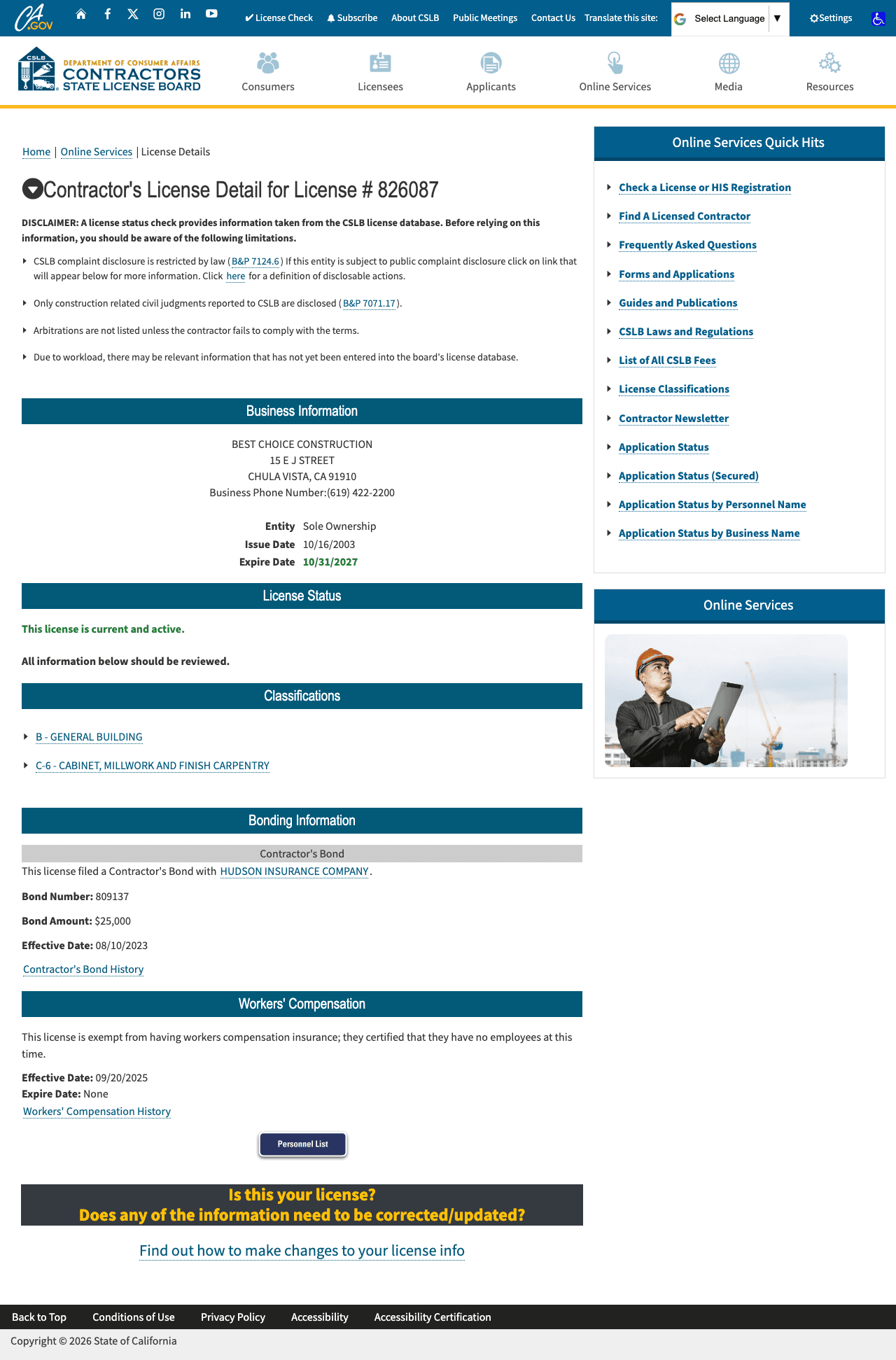
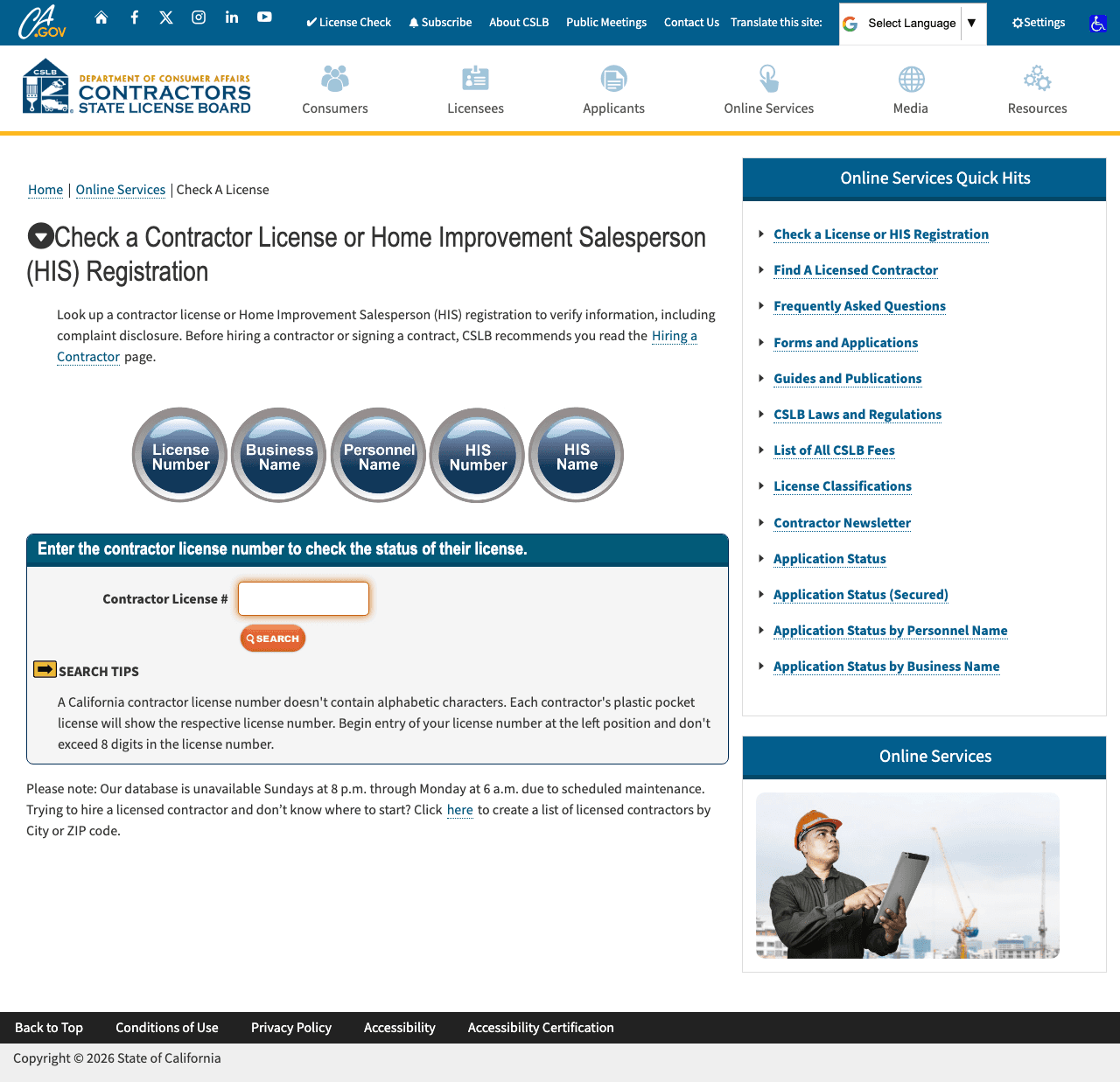
Before hiring any contractor, verify their license status using the CSLB lookup tool. Our guide on how to verify a contractor license in California walks through the process step by step.
Additional Resources
Stop Wasting 47 Minutes Per Contractor
One search. Six data sources. 19 seconds.
CSLB + SAM.gov + OSHA + DOL + EPA + building permits—aggregated, timestamped, and ready for your compliance files.
Verify a Contractor NowCA Regulation Watch
Biweekly updates on the CA construction regulation changes that affect how you vet subs.
Free, biweekly. Unsubscribe anytime.